Code
library(photobiology)
library(photobiologyWavebands)
library(photobiologyFilters)
library(photobiologyLamps)
library(photobiologyPlants)
photon_as_default()

library(ggplot2)
theme_set(theme_bw())
library(ggspectra)This page is an early draft.
LED light, ultraviolet, visible, infrared, plants

This page is still a draft, not only of the text. As any work in progress the contents of this page may drastically change, even in some of the conclusions. The methods will be described in detail.
In this page code chunks can be “folded” so as to decrease the clutter. Above each plot, table or other R-code output you may find one or more “folded” code chunks signalled by a small triangle followed by “Code”. Clicking on the triangle “unfolds” folded chunks making the R code that produced the printed values, plots or tables visible. Clicking on the same icon on an “unfolded” chunk, folds it hiding the code.
The code when visible in the chunks can be copied by clicking on the top right corner, where an icon appears when the mouse cursor hovers over the code listing.
The </> Code drop down menu to the right of the page title makes it possible to unfold and fold all code chunks in the page and to view the Quarto source of the whole web page.
The code below attaches R packages to be used and reads in the measured response data and the metadata describing the LEDs and filters used.
library(photobiology)
library(photobiologyWavebands)
library(photobiologyFilters)
library(photobiologyLamps)
library(photobiologyPlants)
photon_as_default()
library(ggplot2)
theme_set(theme_bw())
library(ggspectra)Plants do not absorb significantly in the near infrared (NIR) region of the spectrum, more specifically at what in plant sciences is called far-red region of the spectrum. The ISO definition of red based on human vision reaches all the way to 780 nm. However, in plant sciences we call far-red the region between 700 and 800 nm (Figure 1). The reason is that light absorption by green plant tissues is much less for these wavelengths than for the rest of the visible light spectrum.
autoplot(Ler_leaf.spct) + theme(legend.position = "top")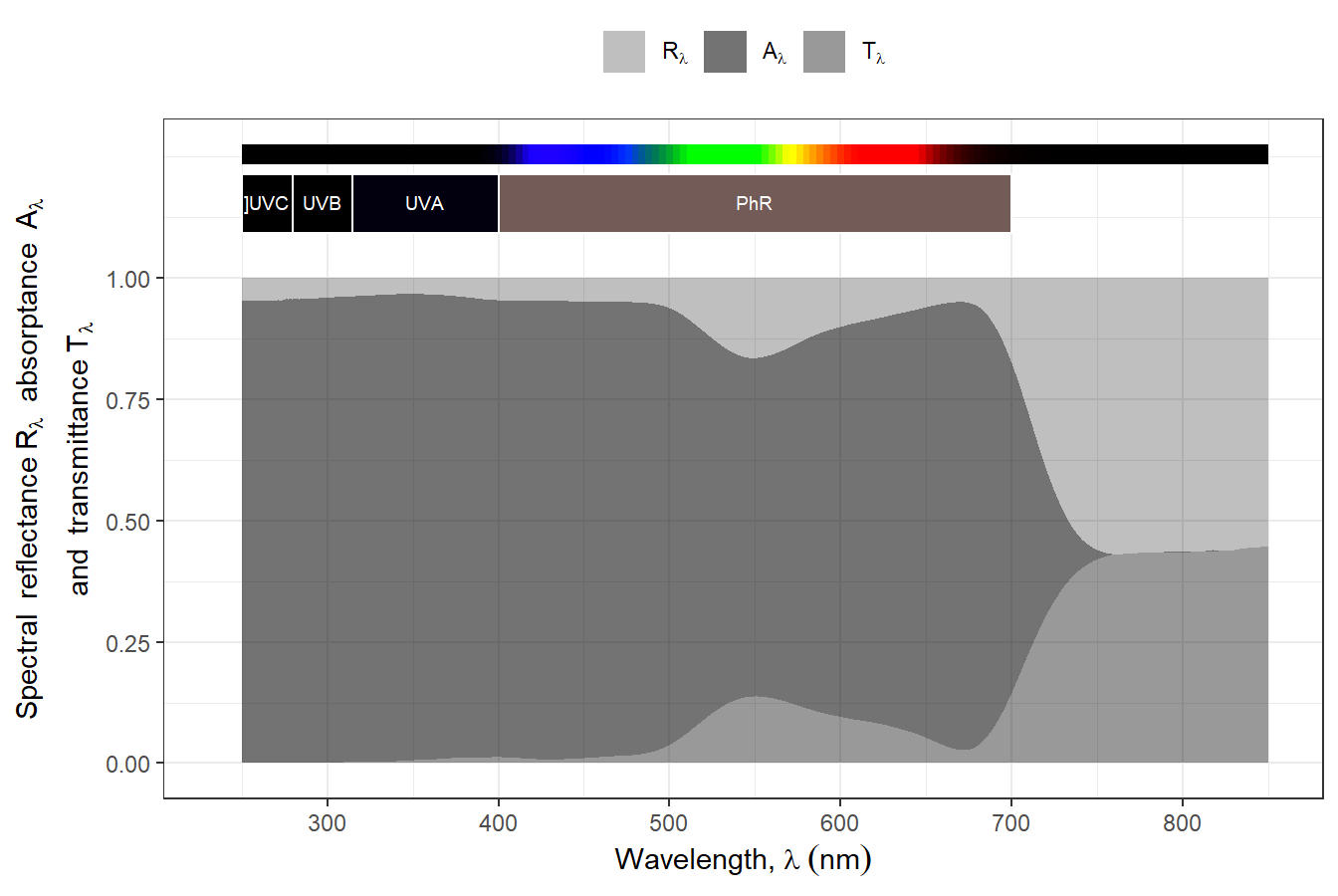
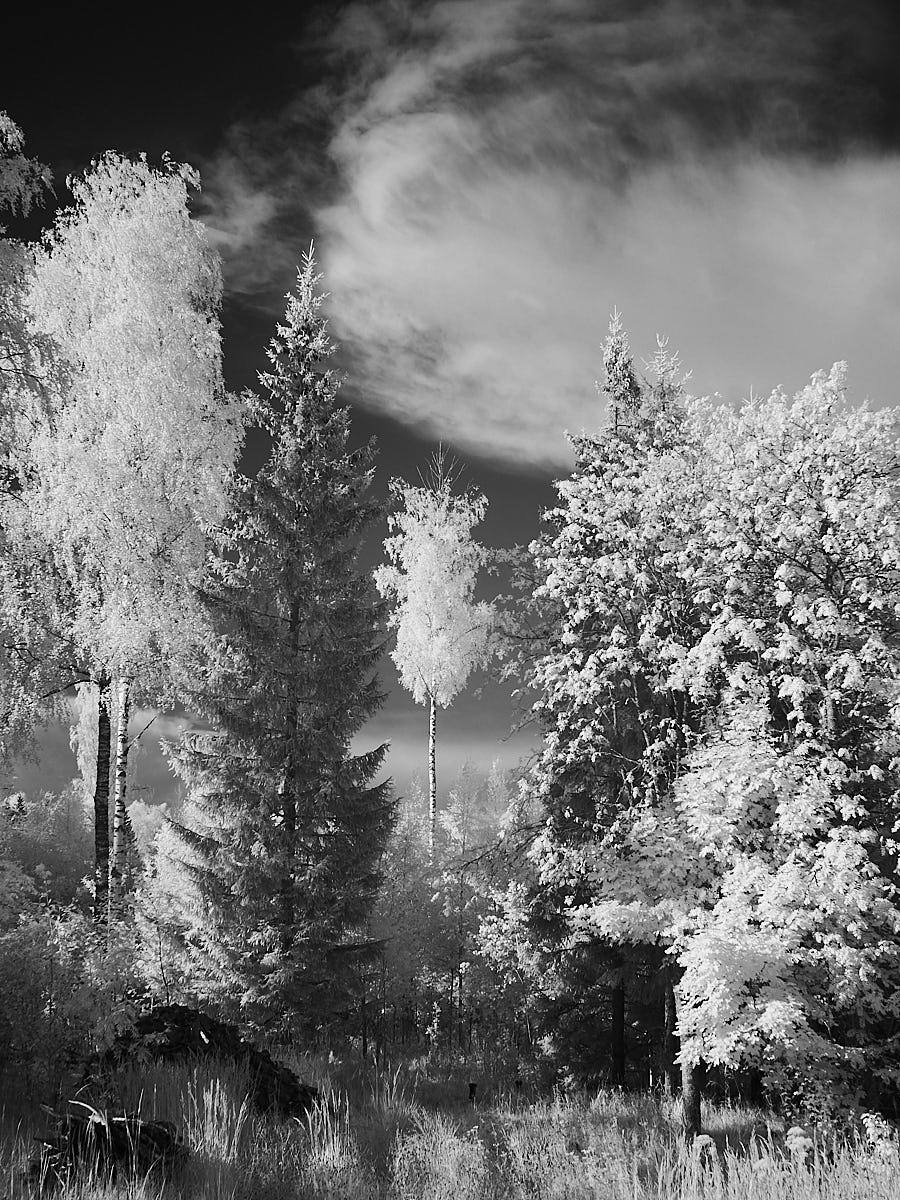
Because of the much higher reflectivity in FR compared to VIS, in photographs based on these wavelengths plants appear almost white and the blue sky almost black (Figure 3). NIR photography provides one possible approach for increasing the contrast between plants’ foliage and the background (e.g., Webb et al., 2022), as long as other plants are not in the background. In turn, higher contrast facilitates the segmentation of an image into plant and not plant pixels. The NIR region of the spectrum is also central to the remote sensing of vegetation both at close distances (drones or land vehicles) to medium (aerial photography) and long distance (satellite instrumentation). At even closer distances it can be useful also when assessing plants’ growth. Monochrome NIR photography has other benefits, and has been in use for aerial photography for more than 100 years, since WW I, as it avoids atmospheric haze from reducing image contrast.
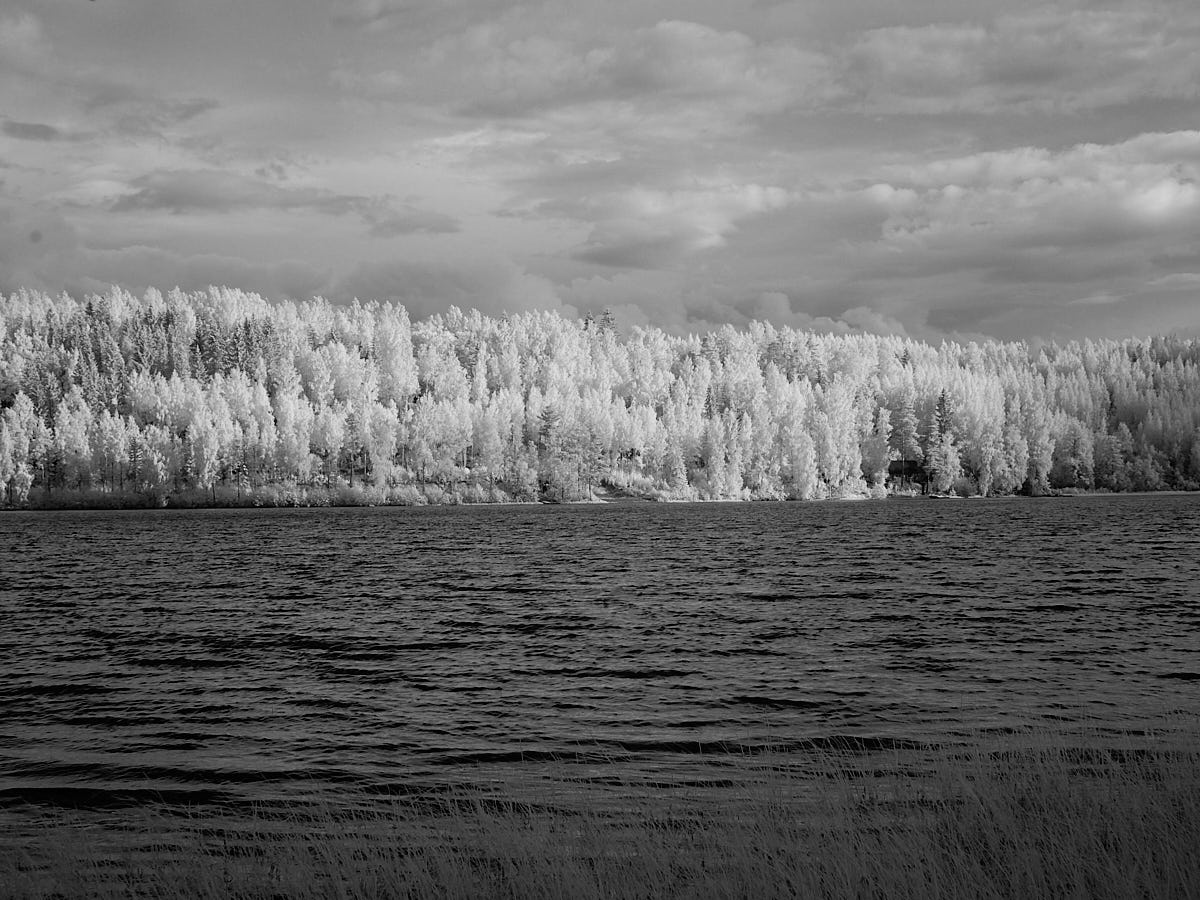
Strong UV-A or blue light induces chlorophyll fluorescence in the red and FR regions. This fluorescence can be observed and photographed when no other R or FR light is present. Fluorescence of chlorophyll and other plant pigments will not be discussed further in this page.
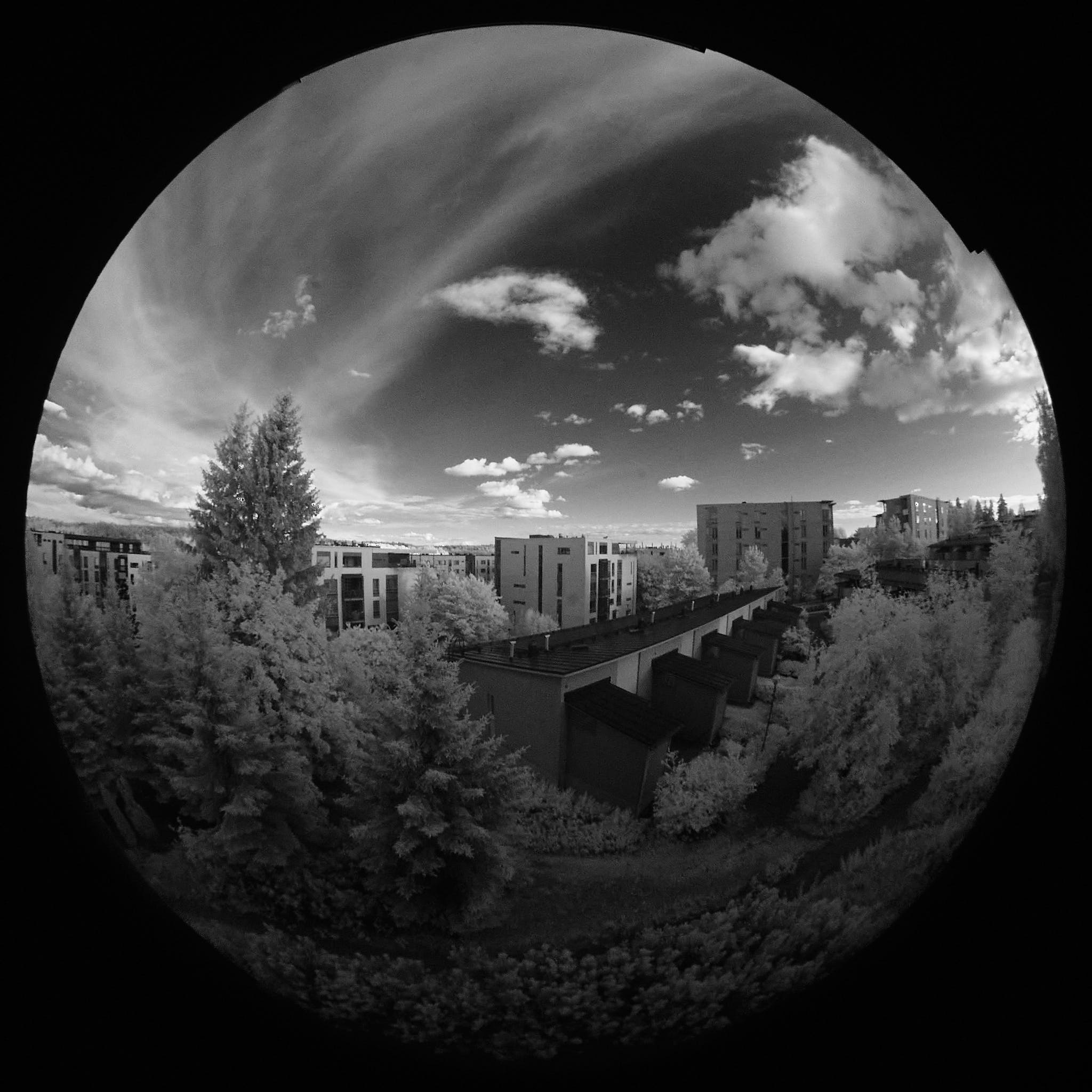
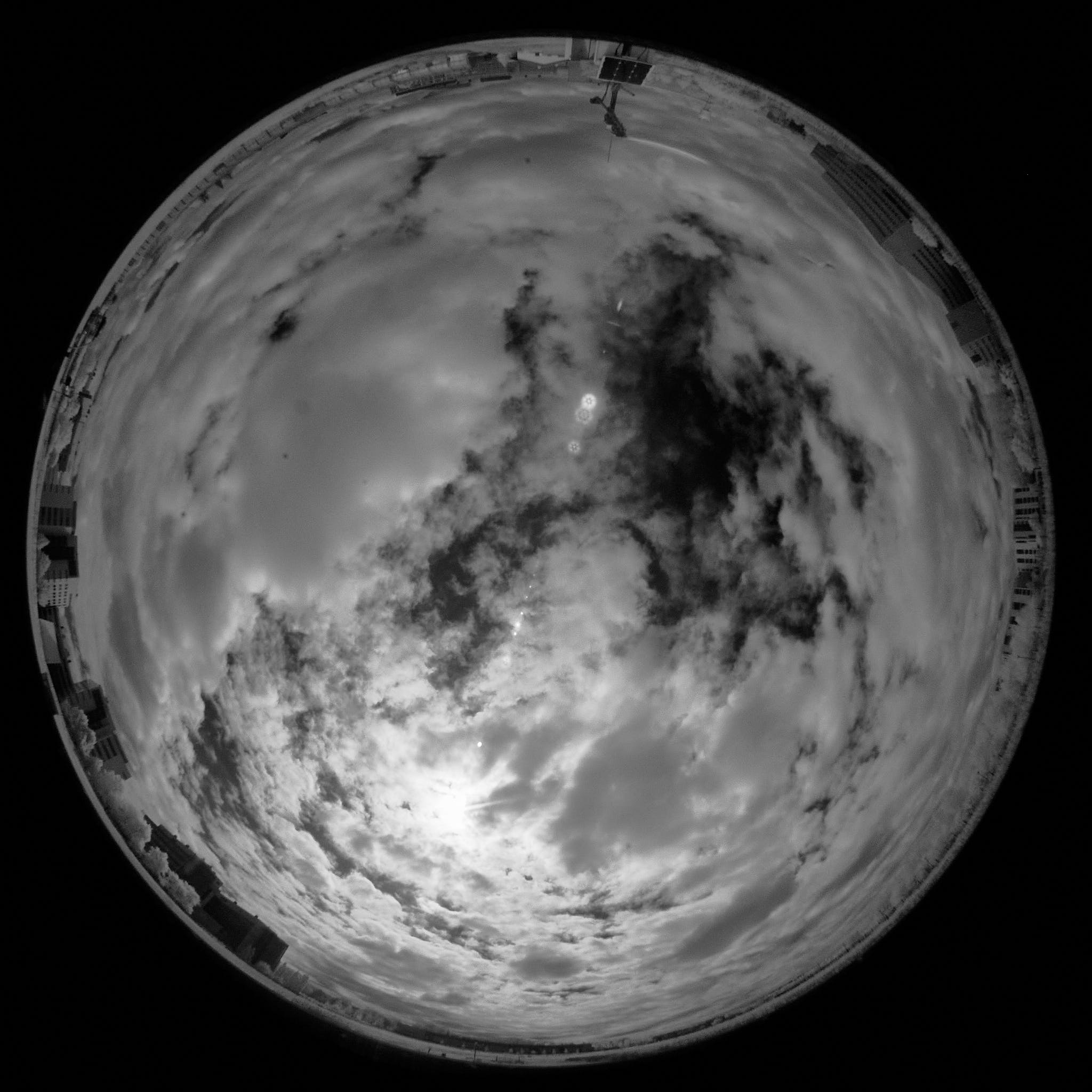
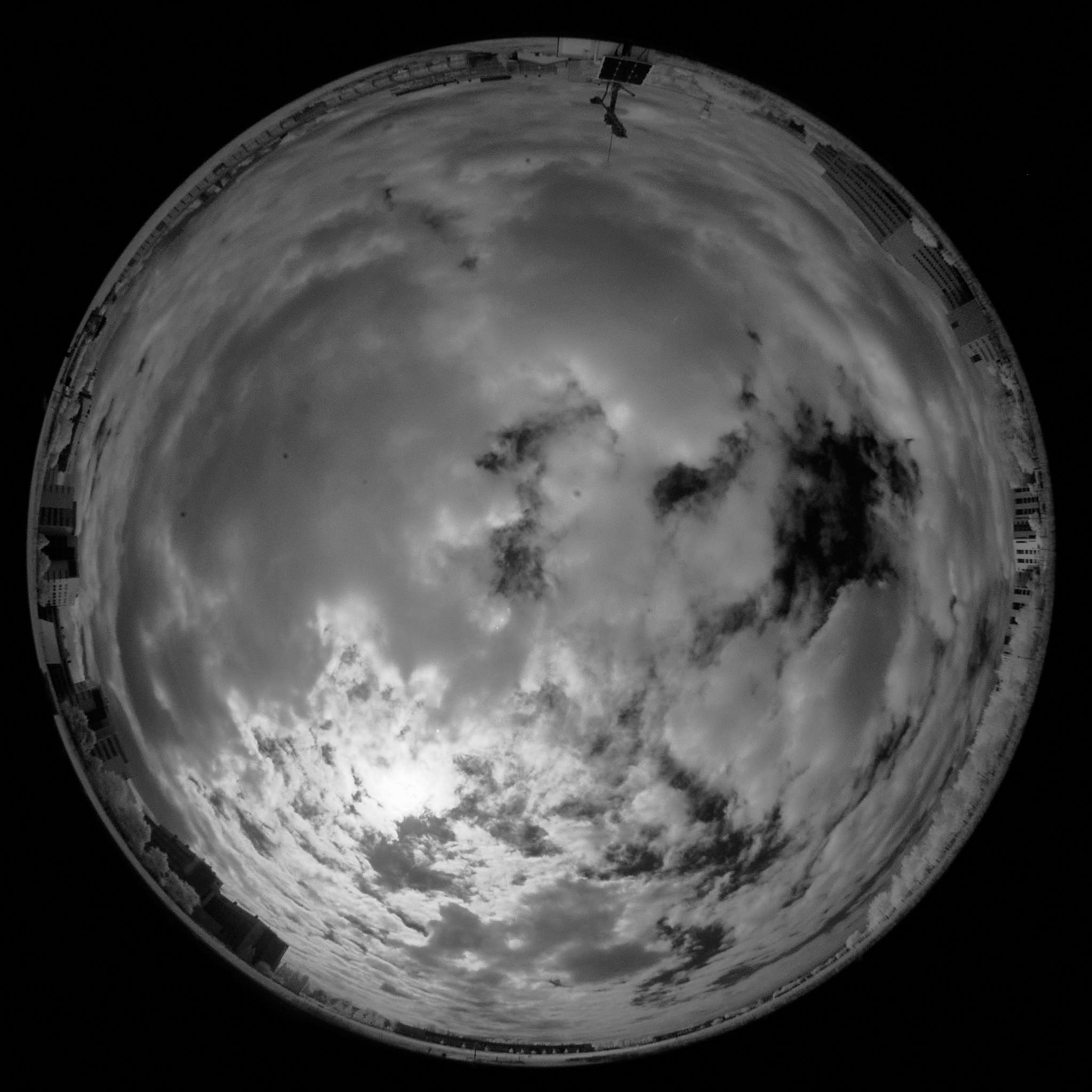
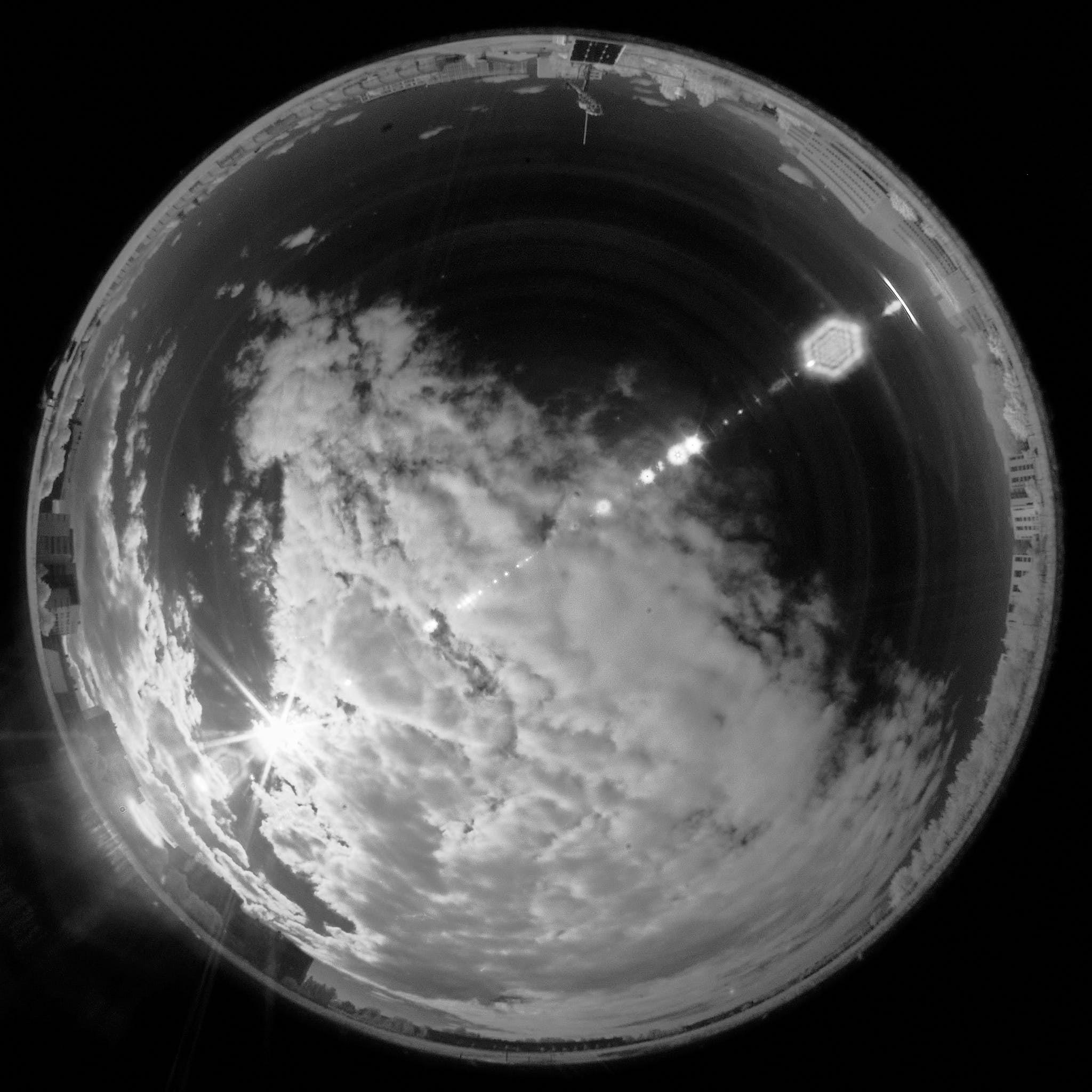
NIR photography can also help in the case of hemispherical photography. When it is used to assess light exposure of plants growing under other plants the usual extremely high contrast between shading vegetation and a bright sky is moderated or even reversed. In this example, reducing contrast is important while in the next example, increasing contrast is beneficial. Independently of vegetation, the luminosity contrast between clouds and the sky is higher in the NIR region of the spectrum than in the VIS, although any filter blocking blue light already significantly helps. In this page I show some examples.
Neither commonly used films or digital cameras are significantly sensitive to NIR. NIR photography with unmodified cameras or normal film is challenging and requires very long exposures. Film specifically formulated for NIR sensitivity was used with film cameras, both black and white and false-colour film have been available in the past. Normal digital photographic cameras have a NIR-blocking filter protecting the sensor, and are only weakly sensitive to the longer wavelengths of NIR. There exist both specialized off-the-shelf cameras sensitive to NIR and the possibility of having the NIR-blocking filter in a normal camera replaced by NIR (and UV) transmitting glass (“full-spectrum”) or by a given NIR-passing and VIS-blocking filter. The photographs illustrating this page were taken a “full-spectrum” converted digital camera. Please, see the page Camera spectral response: Full-spectrum Olympus E-M1 for additional details. False-colour NIR photography is in most cases an accident of using converted digital colour cameras, as the dyes used for the red, green, and blue filters on the sensor photosites differ in their spectral transmittance in the range 700 to 800 nm. At longer wavelengths, no false colour is rendered as the three dyes behave nearly identically (see page cited above).
The photographs shown in this article have been captured as raw files and converted to black and white in post-processing.
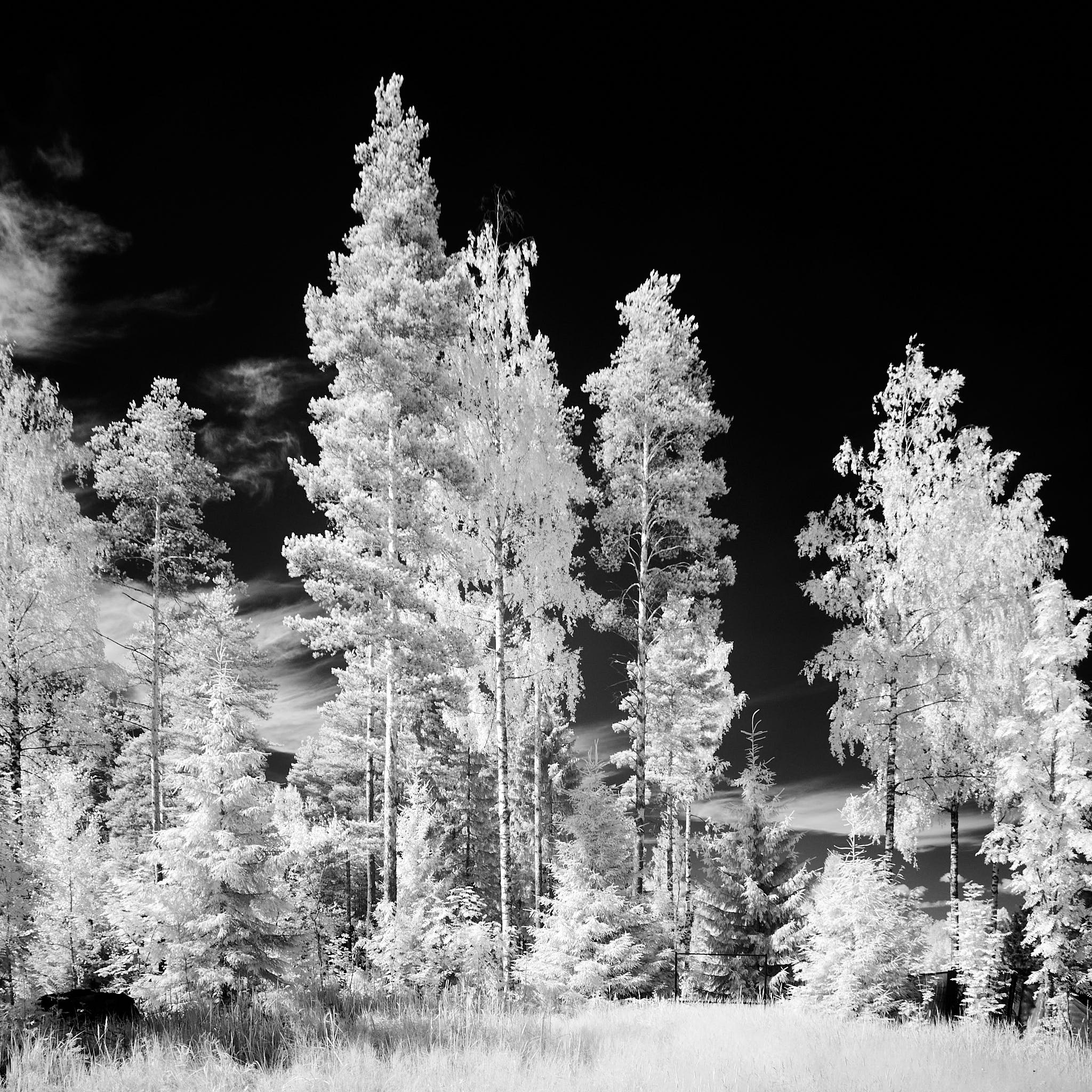
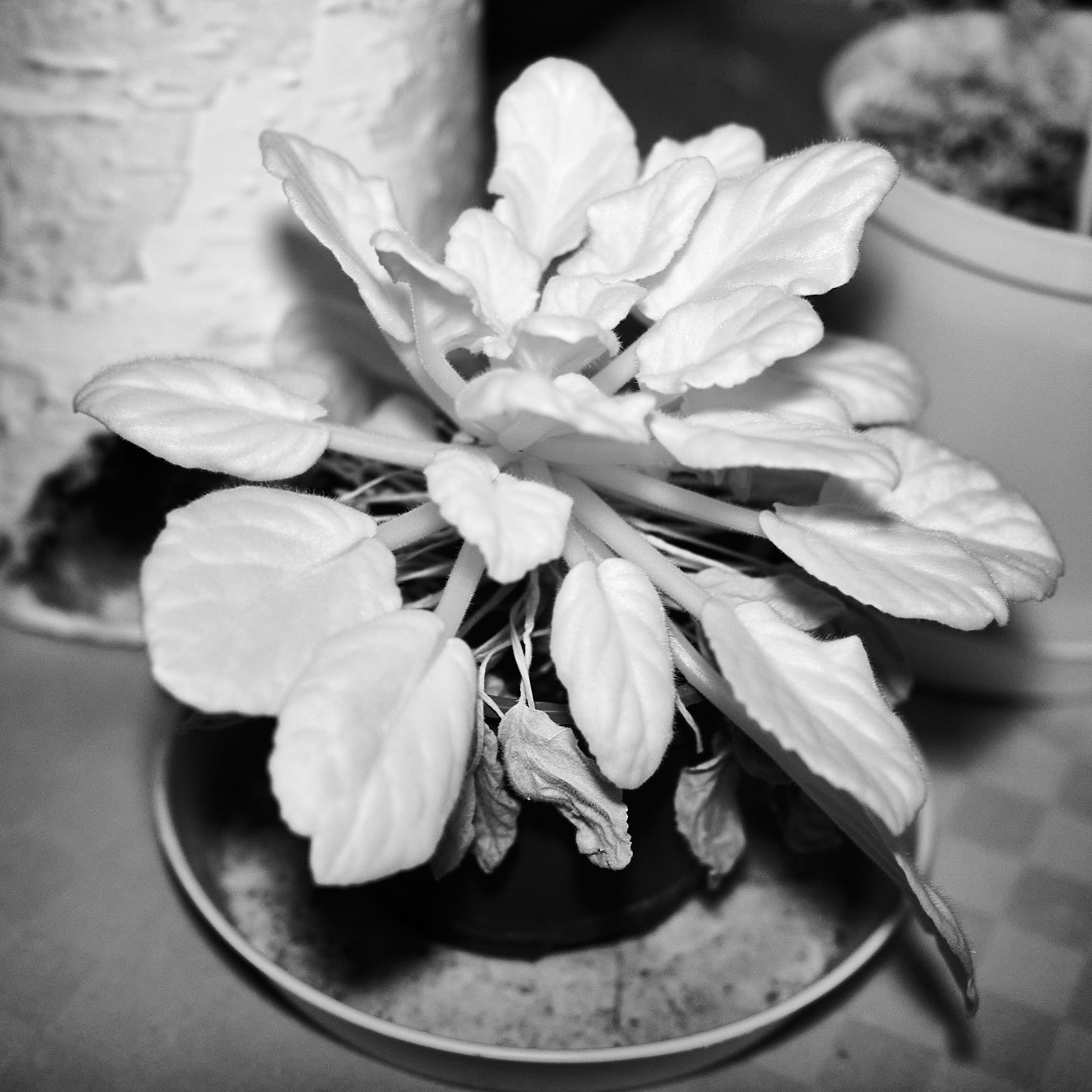
NIR radiation is reflected by plants, thus, its intensity depneds on the incident NIR irradiance. In an image where part of the vegetation is in the shade and part in the shade, the brightness in the image will strongly differ, in general more than the difference in brightness we see in the green. Differences in illumination among plants must not be confused with differences in reflectance.
Differences in NIR reflectance among green plants are small, but how noticeable they are can depend on the filter used. A full-spectrum converted camera is very sensitive to NIR, thus, foliage appears nearly white even when using a yellow or an orange filter. This is because reflectance is very high in the NIR compared to the visible. In an off-the-shelf camera, which has very low sensitivity to NIR, this effect can be seen only when using filters blocking more of the VIS light. The NIR reflectance of bark, dry stems, and seed pods varies more, and some are dark as they reflect NIR weakly
https://digitalcommons.usu.edu/cpl_techniquesinstruments/20/