# Breakouts initialization sequence is:
# - initialize BLINKA
# - initialize I2C in MCP2221
# - initialize GPIO
# - initialize DACs
#
# set OS environment variable
from signal import CTRL_BREAK_EVENT
import os; os.environ["BLINKA_MCP2221"] = "1"

import time

# USB boards attached
import board

import digitalio
# GPIO pins of MCP2221A
# common ground with USB, here used to drive optocouplers
# no direct connection used as the MCP2221A is not isolated from host PC

# e.g. as a camera shutter trigger using TRS 2.5mm
#  AQW212EH bidirectional MOSFET 2 channel SSR
#  GPIO at G0 and G1 wired to pins 1 and 3

# common to both switches to "shield" (ground of stereo signal)
# "half press", connected "ring" of TRS (R = right stereo channel)
trigger0 = digitalio.DigitalInOut(board.G0)
trigger0.direction = digitalio.Direction.OUTPUT
# "full press", connected "tip" of TRS (L = left stereo channel)
trigger1 = digitalio.DigitalInOut(board.G1)
trigger1.direction = digitalio.Direction.OUTPUT

# For the OM-1 Mk-1 even the fastest possible contact closure is long enough
# to triggers the camera shutter.shutter
# the AQW212EH has maximum turn-on- and turn-off time of 4 ms and 1 ms
def shutter(duration_s = 0.005, delay_s = 0):
       """Trigger camera shutter, closing only 'full-press' contact"""
       time.sleep(delay_s)
       trigger1.value = True
       if duration_s > 0:
        time.sleep(duration_s)
       trigger1.value = False

# With the OM-1 pre-focus seems to be unnecessary, and this function overkill
# the "normal" trigger-press sequence could be needed with other cameras or
# in specific camera modes.
def half_and_shutter(duration_s = 0.005, prefocus_s = 0.1):
       """Trigger camera shutter, closing first 'half-press' contact followed by 'full-press' contact"""
       trigger0.value = True
       time.sleep(prefocus_s)
       trigger1.value = True
       time.sleep(duration_s)
       trigger1.value = False
       trigger0.value = False

shutter() # very brief trigger "full press"
shutter(1, 5) # 1 s trigger "full press" after a delay of 5 s

half_and_shutter(0) # very brief trigger "full press", default 0.1 s "half press"
half_and_shutter(1, 5) # 1 s trigger "full press" after a 5 s "half press"Introduction
With cameras like the Olympus OM-1 in normal use there is seldom need to use a wired trigger. The camera supports Bluetooth and WiFi and the free app from OM-System can be used both as a simple trigger and a a camera remote. The camera can the also tethered to a computer with the free OM Capture software. Tethering is possible both through USB and WiFi.
The limitation is that there is no public API to the communication protocols the OM-1 camera uses, and these protocols are most likely specific to recent OM-cameras.
A simple trigger that simulates switch closure controlled through USB can be useful as part of an automation set-up where software running in a personal computer or a single-board computer (SBC) controls lights that need to be well synchronized with the triggering of the shutter of a camera.
Requirements
- Support for a broad range of computer hardware with little change to the program code.
- Availability of software libraries and documentation.
- Reliable triggering.
- Silent.
- Safe the to controlled camera and to the controlling computer.
- Compatible with most digital cameras supporting wired triggers.
- USB-powered.
- Easy to build.
- Reasonable cost.
A simple solution
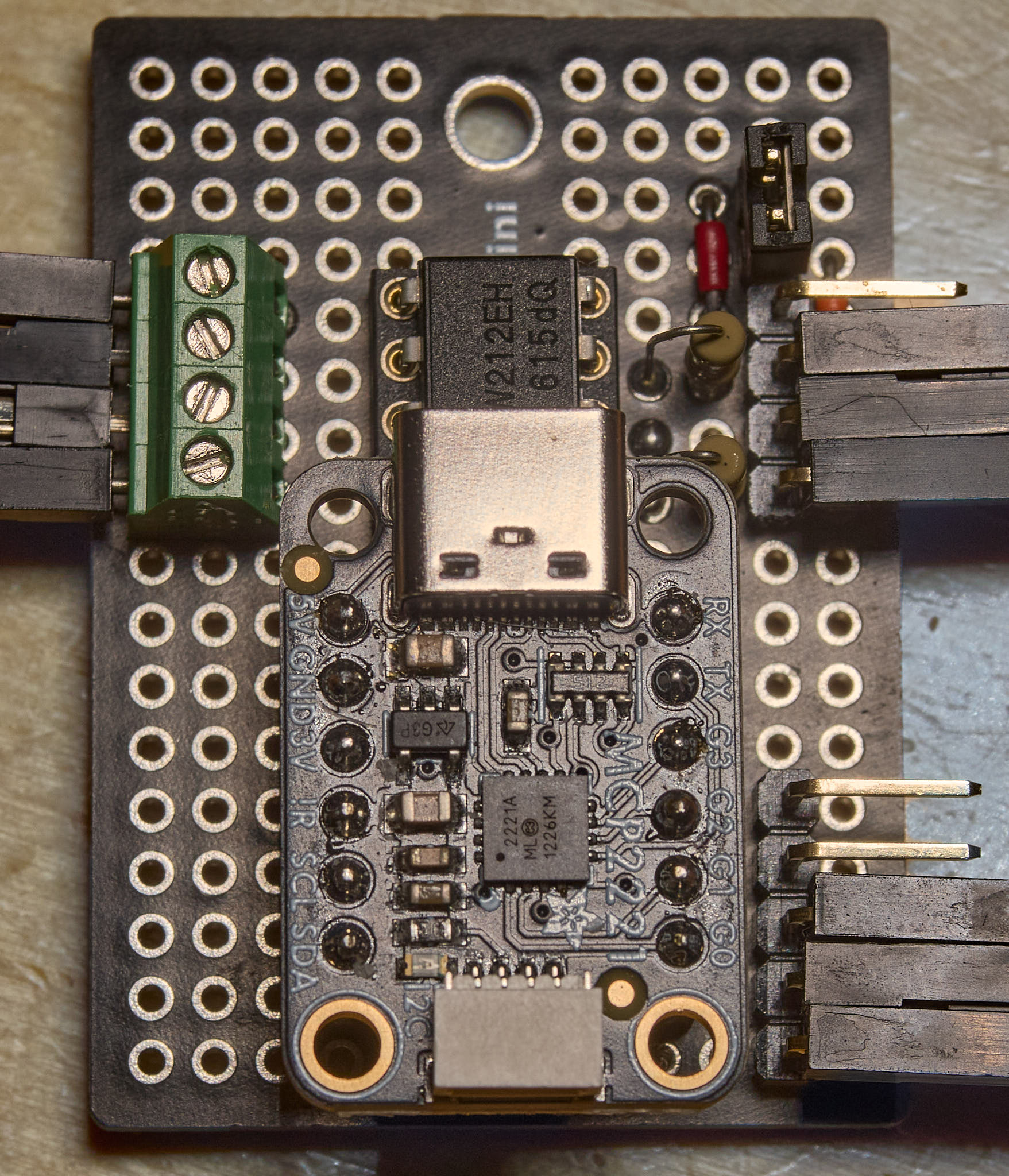
- Use a MCP2221A breakout board (Adafruit Product ID: 4471) and bidirectional MOSFET opto-couplers (Panasonic AQW212EH in DIP8 package, bought from DigiKey).
- A bidirectional MOSFET optocoupler is functionally similar to a mechanical switch as it is polarity agnostic and has a very low resistance when active and a very low leakage current when not active.
- The AQW212EH requires a rather low LED current to activate the MOSFETs of less than 4 mA and a maximum LED current of 50 mA. With the 3.3 V logic output from the MCP2221A GPIO pins in output mode, a 1.2 V drop across the LED and 470 ohm series resistors, the requirements for triggering are fulfilled.
- MOSFETs are slower than bipolar transistors, but the AQW212EH with a typical turn on time of 1 ms and a typical turn-off time of 0.08 ms should be fast enough.
- At 3€ the AQW212EH is more expensive than the ubiquitous transistor optocoupler PC827 that costs less than 0.50€. The MCP2221A breakout from Adafruit costs 6€.
I designed the “test bed” prototype to be as easy to modify as possible using a miniature “breadboard PCB” and sockets for the optocouplers and the MCP2221A breakout board, using Dupont 0.1” headers and jumpers to connect the MCP2221A to the optocouplers.
The MCP2221A USB-bridge has four GPIO pins, only two of which are needed for triggering a camera and it is also an I2C bridge, acting as controller in a I2C bus through which multiple breakout boards with circuits for diverse functions can be connected.
A simple Python script
This script was tested under Windows 11 Pro within the Positron IDE with an OM-1 (Mk 1) camera.
Possible variations
The AQW212EH optocoupler can be driven directly by SBC and microcontroller boards, as well as with other USB interface boards based on other USB bridge integrated circuits. With minimal changes the same script should work, in the case of MCBs using CircuitPython instead of the Blinka module. USB-bridge breakout boards based on the MCP2222 (Adafruit Product ID: 6559) and on the FT232H (Adafruit Product ID: 2264) would most likely support the same script with minimal changes. Similar breakout boards from other suppliers should also work. MCBs based on ESP32-series SIPs could be used for wireless triggering using a variety of different communication protocols.
Further reading
Adafruit MCP2221A documentation
AI was not used for the choice of components or design of the trigger. AI was used to review the design, choice of optocupler and to search for information about the wiring of the TRS 2.5 mm jack in the OM-1 camera and in Canon cameras. The LLM model used was the free online DeepSeek chat on 2026-11-15.