Code
library(photobiologyFilters)Loading required package: photobiology
Loading required package: SunCalcMeeus
Documentation at https://docs.r4photobiology.info/
Code
library(ggspectra)Loading required package: ggplot2
Notes on its use and performance
Pedro J. Aphalo
2026-10-12
2026-10-12
OM-1 digital, BSI sensor, full-spectrum
Loading required package: photobiology
Loading required package: SunCalcMeeus
Documentation at https://docs.r4photobiology.info/
Loading required package: ggplot2
I have had an Olympus OM-1 digital camera converted to full spectrum by replacement of the original filter stack by a filter HEBO UV 280 (HEBO Spezialglas, Aalen, Germany), similar to Schott WG-280. The conversion was done by IRreCams Lamprecht (Dreschvitz, Germany).
Now I have two identical cameras, one in its original condition, and one converted to full spectrum. Please, see the page “Notes on the OM-1 (digital) camera for my notes on the use of the camera with its original sensor filter. OM-System has announced an original variant of the OM-1 Mk II for IR photography with a sensor filter that block UV but transmits VIS and NIR. Last year a variant of the OM-3 camera for astrophotography, also with a non-standard sensor filter, with enhanced sensitivity in the red.
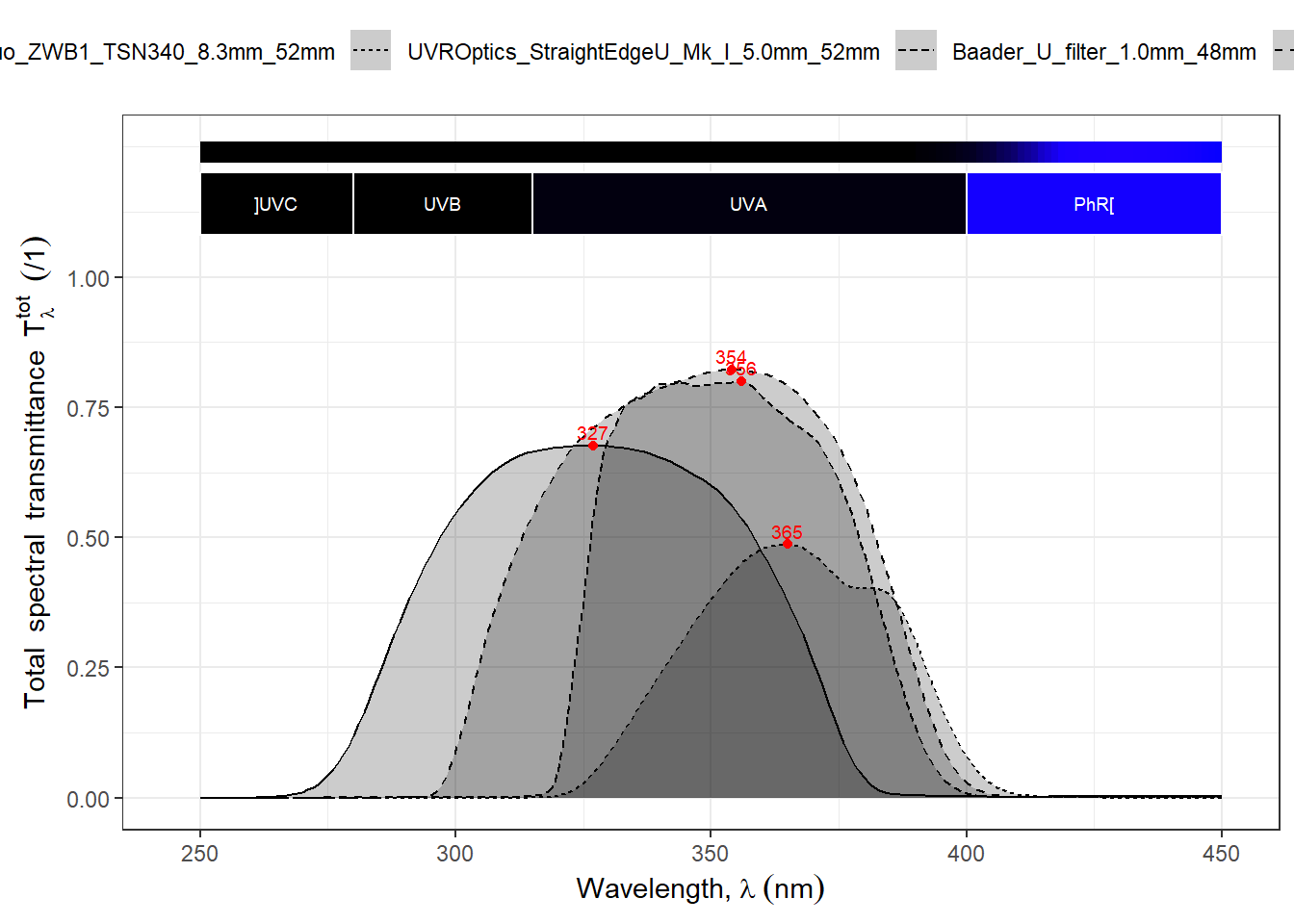
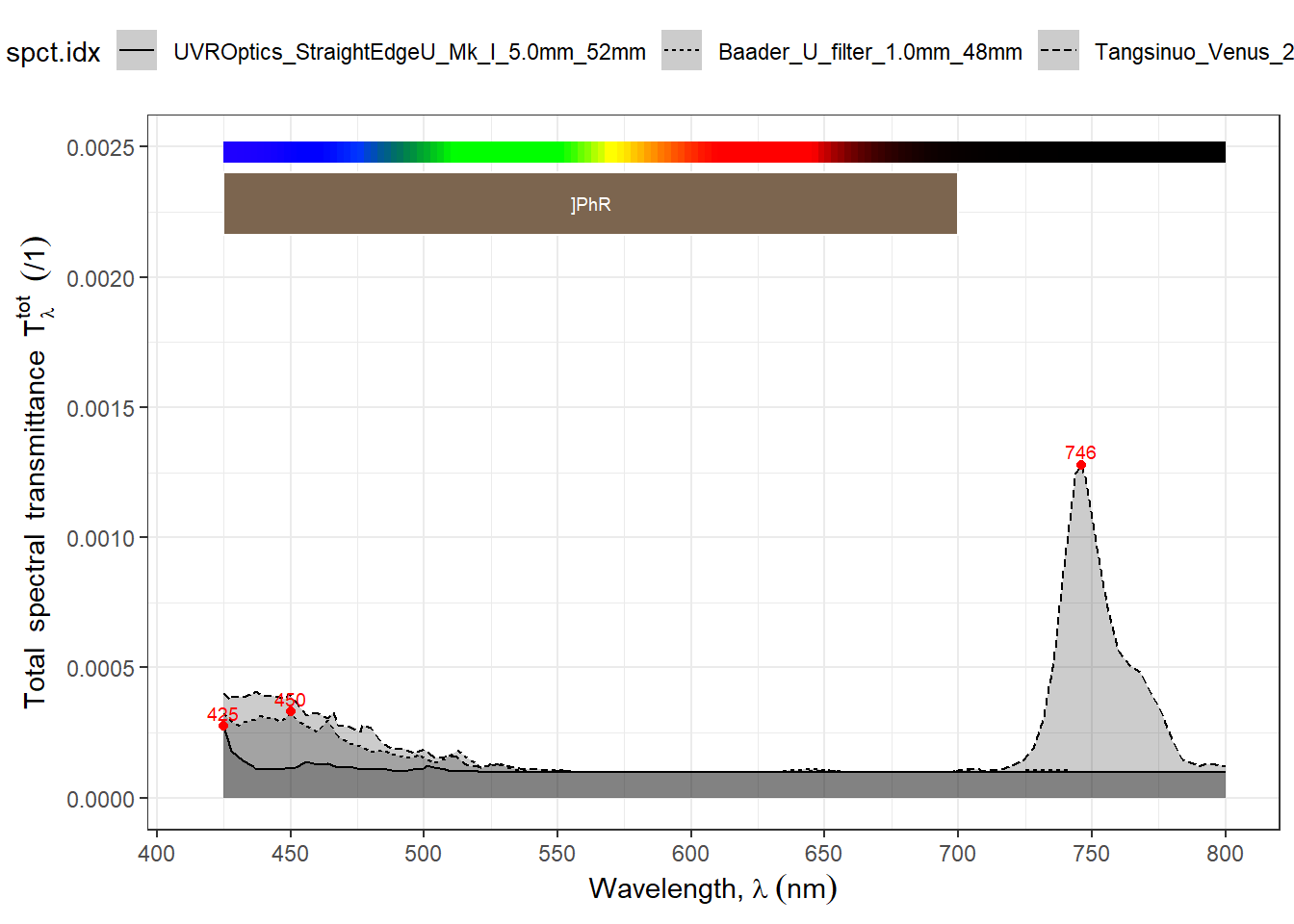
In a discussion about this filter at https://www.Ultravioletphotography.com the possibility of the yellow tint in photographs taken with the TSN340 filter being due to a red-NIR leak was considered. The difference between the Soligor 35 mm f:3.5 and the Nikkor lens when using this same filter indicates that the colour is most likely from the shorter UV wavelengths tarnsmitted by this filter.
Discarding heterogeous 'filter.descriptor' attributes!!
---
title: "A 'full-spectrum' OM-1 (digital) camera"
subtitle: "Notes on its use and performance"
author: "Pedro J. Aphalo"
date: "2026-10-12"
date-modified: "2026-10-12"
toc: true
categories: [cameras]
keywords: [OM-1 digital, BSI sensor, full-spectrum]
format:
html:
code-fold: true
code-tools: true
image: images/OM-1-menu.jpg
lightbox: auto
license: "CC BY-SA"
abstract:
"This page collects notes I have written about an OM-1 digital camera that was converted by IRrcams to full spectrum in 2026. The notes were originally intended for my own use as an aide-memoire. I have added some explanations so that they can be also useful to others. I update this page from time to time, tracking firmware updates and the experience gained in various types of UV and NIR photography (not video)."
draft: true
---
```{r}
library(photobiologyFilters)
library(ggspectra)
```
## Introduction
I have had an Olympus OM-1 digital camera converted to full spectrum by replacement of the original filter stack by a filter HEBO UV 280 ([HEBO Spezialglas](https://www.hebo-glass.com/en), Aalen, Germany), similar to Schott WG-280. The conversion was done by [IRreCams Lamprecht](https://irrecams.de/en/) (Dreschvitz, Germany).
Now I have two identical cameras, one in its original condition, and one converted to full spectrum. Please, see the page ["Notes on the OM-1 (digital) camera](OM1-notes.qmd) for my notes on the use of the camera with its original sensor filter. OM-System has announced an original variant of the OM-1 Mk II for IR photography with a sensor filter that block UV but transmits VIS and NIR. Last year a variant of the OM-3 camera for astrophotography, also with a non-standard sensor filter, with enhanced sensitivity in the red.
## First quick tests
### General
- Hand-held sensor-shift high resolution mode works normally in NIR and UV. This not only increases resolution but helps reduce sensor noise at high ISO.
- Sensor-based image stabilization also seems to work normally. Thus by setting focal length also with adapted lenses.
- Capture One's 16.8.x enhanced denoise works well with NIR and UV ORF raw files. Tested at ISO 12800.
- The sensor is clean and the filter has no defects. Tested with a pinhole lens (Thingyfy Pinhole Pro, in MFT mount) with a focal length of 26 mm and the aperture set to its minimum of 0.1 mm (f:260). This is the most stringent test possible as such a small aperture brings the sensor filter into focus.
### UV
- UV sensitivity is good and reaches to short enough wavelengths for RAW files taken with a Soligor 35 mm f:3.5 "classic" lens and a TSN340 filter from Tangsinuo (SBW1 8.3 mm-thick) to be predominantly yellow before white balancing. In contrast under the same conditions, the TSN340 does not let through enough light for taking an image with the Nikkor AI . With the StrightEdgeU filter from UVROptics the RAW files are bluer and similar with the Nikkor and Soligor Lenses.
### NIR
- NIR sensitivity is high, as expected.
## VIS
- With a QB21 filter auto white-balance works fairly well in sunlight/daylight, even without using a white or grey card. CCT seems correct but with the tint slightly too green.
::: callout-note
# TSN340 filter
In a discussion about this filter at [https://www.Ultravioletphotography.com](https://www.Ultravioletphotography.com) the possibility of the yellow tint in photographs taken with the TSN340 filter being due to a red-NIR leak was considered. The difference between the Soligor 35 mm f:3.5 and the Nikkor lens when using this same filter indicates that the colour is most likely from the shorter UV wavelengths tarnsmitted by this filter.
```{r}
autoplot(filters.mspct[c("Tangsinuo_ZWB1_TSN340_8.3mm_52mm",
"UVROptics_StraightEdgeU_Mk_I_5.0mm_52mm",
"Baader_U_filter_1.0mm_48mm",
"Tangsinuo_Venus_2mm_30.5mm")],
range = c(250, 450), geom = c("spct", "line")) +
theme_bw() +
theme(legend.position = "top")
```
```{r}
autoplot(filters.mspct[c(#"Tangsinuo_ZWB1_TSN340_8.3mm_52mm",
"UVROptics_StraightEdgeU_Mk_I_5.0mm_52mm",
"Baader_U_filter_1.0mm_48mm",
"Tangsinuo_Venus_2mm_30.5mm")],
range = c(425, 800),
ylim = c(NA, 0.002),
geom = c("spct", "line")) +
theme_bw() +
theme(legend.position = "top")
```
:::